
Take it from us, what is buried can come back to haunt you. If you’ve ever had a sewer line backup into your home, basement or sink, you know exactly what we’re talking about. It’s a nightmare.
Sewer lines are like arteries; it’s good to know what’s going on in them. Think about it, the sewer line is the hardest-working pipe in the home. And it’s hidden. Under the basement, under the ground. Like your arteries, wouldn’t you want to know if everything is flowing healthily?
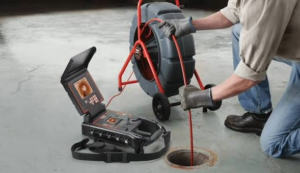
Inspecting sewer lines is straightforward. A cable is inserted in the line. It travels down the pipe, recording on video what it sees. We do it every day. And we’ve seen some wild things. No, sorry, no alligators, but we’ve seen many a spider and, of course, we’ve found Nemo a few times.
Most of the homes in the Ann Arbor area were built in the middle of the last century. That means, at a minimum, they have old pipes and, most likely, chances are, those pipes were made of either clay or Orangburg. Clay pipes crack over time, especially if they run underneath old, large trees. Big tree roots can crush a clay pipe or at least break a chunk out of it. The roots then setting in, seeking water.
Orangburg, a composite of coal tar and wood pulp, is basically a cardboard pipe. And we all know how well cardboard does in wet conditions. Over time and continued exposure to moisture, it loses its integrity. It delaminates, flattens and warps. Naturally, none of that is good for outward flow.
The other type of sewer material used in the Washtenaw County area is cast iron. Cast iron is just what it says — iron pipe. Iron and water do not often do well with each other. Cast iron pipe can also deteriorate and either crack or break. If this happens, water can spill into the ground and cause the surrounding ground to wash away. If it breaks or collapses, the sewer will not drain. This is why it is important to have these types of lines inspected, to prevent a failure of your sewage system.
The good news, with a simple look, the health of your sewer line can be known. You can stand right next to us as we feed the line down the pipe. You can see what we see. Nothing to hide, because, after all, that’s the whole point, isn’t it.
Of course, this logic does not just apply to the home you own. If you’re buying a home, it’s a great idea to include a sewer line inspection as part of the larger home inspection. In fact, most real estate agents now recommend looking at the sewer line as part of the larger assessment of a home.
Our sewer line experts not only inspect, but they also clean out lines with hydropower jetting. They also, if needed, replace sewer lines. But let’s jump to that conclusion without taking a look first. Give Hutzel a call and we will have someone come out.